

The Clay Pot Labels by the Kitchen Window, and a Neighbor's Green Powder

 Kitchen Window · The Growing Row
A retired biology teacher counts the words that hide on the tip of her tongue, beside a row of clay pots and a neighbor's green herb. The label, the research and the other plant called brahmi, read honestly.
On a Saturday at the end of June, my grandson Owen pointed at a plant on my potting bench and asked me what it was called.
He's eight, and he asks the way I used to teach: finger on the leaf, eyes on my face.
It was a spider plant, the striped kind every classroom in Ohio has on a windowsill.
I had taught its Latin name to thirty-one years of sophomores, and I opened my mouth and nothing came out.
I knew the shape of the word. I knew it started with a hard sound, and I could see the chalk on the board in Room 114.
The name came back at ten past four that afternoon, while I was filling the watering can.
*Chlorophytum comosum.* I said it out loud to an empty greenhouse, and then I sat down on the step stool and laughed, because what else do you do.
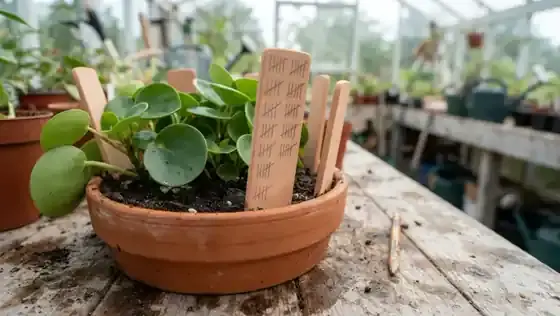
That night I took a clay pot label, the plain kind you push into the soil, and made a pencil mark on it.
One mark for one word that stayed just out of reach on the tip of my tongue.
This is a column about those marks.
It's also about a row of clay pots, a neighbor from Chennai who grows a round green leaf in a pan of wet soil, and a kraft paper bag of powder from New Mexico.
And it's about what a biology teacher does when the thing she's studying is herself.
If you've ever stood in a grocery aisle waiting for a word to come home, you'll know most of this already.
Thirty-One Years of Explaining Leaves
I taught biology at the high school in Zanesville, Ohio, from 1988 until the spring of 2019.
Room 114 had a north window, a leaking sink and a philodendron that outlived three principals.
Every October I did the leaf lab.
Thirty teenagers, a stack of maples and oaks from the parking lot, and a strip of chalk paper that pulled the green apart into yellows and oranges they never knew were in there.
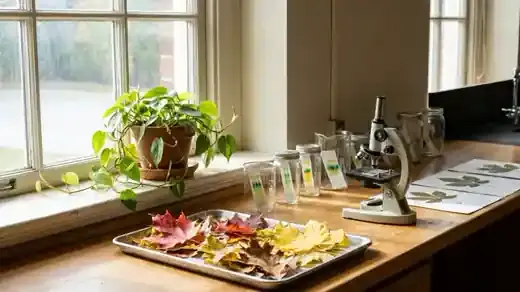
The kids called it "the leaf thing." Former students still stop me at the Kroger to tell me they think about the leaf thing every fall.
The lesson I cared about most was never on the test.
A leaf is not the same leaf twice; it changes with the season, with the light, with the water it gets.
You don't judge a plant by one Tuesday. You watch it over weeks, and you write down what you see, even when what you see is nothing.
I said that sentence so many times that my husband Gene can recite it.
He says it back to me now, in my own teacher voice, when I'm being impatient with a tomato.
Gene is a retired county surveyor.
He spent forty years measuring other people's property lines, and he believes nearly every problem in life can be solved with a tape measure and a level.
When I retired, he measured the back of our kitchen. Then he built me a lean-to greenhouse against the south wall, eight feet long, with old storm windows from his brother's barn.
It has one long bench made from a church pew that a congregation in Dresden was throwing out. On that bench, in a single row, sit the clay pots.
Our granddaughter named it the Row when she was five, and the name stuck. Gene calls it "the Row" the way other men say "the shop."
When the Word Is in the Room but Won't Sit Down
The spider plant wasn't the first time. It was just the first time I wrote one down.
Once I started making marks, I noticed how many there were. The word on the tip of the tongue had been visiting for a while, and I'd been filing it under "tired."
There was the name of the neighbor of thirty years. Loretta Kowalski has lived across the street since 1994; she brought us a lasagna when Gene had his knee done.
In April, I met her by the bananas at the Kroger and talked to her for five full minutes without her name.
I said "hon" four times, which I never say, and she knew something was off because she's known me since our girls were in Brownies.
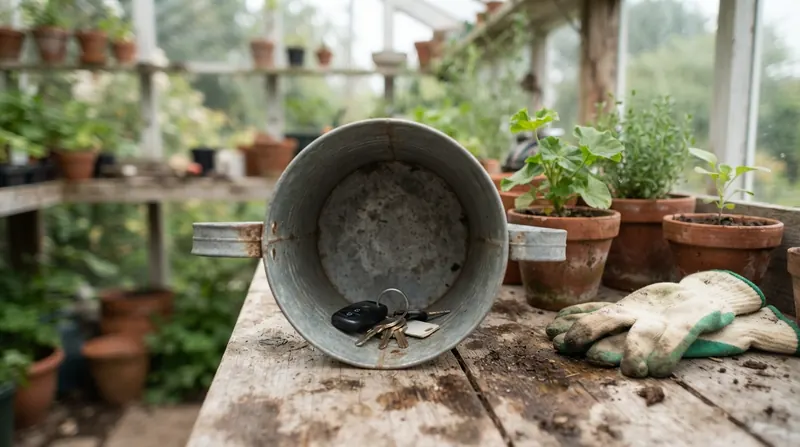
There were the keys that moved. Twice in May they turned up inside the watering can, which tells you exactly where my mind was when I came in from the car.
There was the list I forgot at the store. Not forgot to bring, which everybody does;
forgot I'd written, and then wrote again, and found both lists in my coat pocket in July.
And there were the words, mostly the words. The name of the actor in the movie, the street where my sister used to live, *philodendron* on the one day I needed it.
I want to be careful here, because I taught the nervous system for thirty-one years and I know how frightening it is to read about it.
I'm not describing anything a clinician would put a name to.
I'm describing the ordinary thing most of us start to notice somewhere past sixty. The word that arrives late, the name that comes back at ten past four.
I'd also be lying if I said it didn't scare me a little.
When you've spent your life explaining how a brain stores a word, losing one in front of your grandson feels like a pop quiz you didn't study for.
What My Clinician Said About the Marks on a Clay Pot Label
At my yearly checkup in July, I brought the clay pot label in my purse. It had nineteen marks on it by then, in pencil, front and back.
My clinician is a young woman who reminds me of my best students: she listens with her whole face. She turned the label over in her fingers like it was a specimen.
She asked good questions. Did the words come back later, or never come back at all?
Did I ever get lost driving somewhere familiar? Was I paying bills, cooking, keeping up with the garden club minutes?
The words came back, every one of them, usually within the hour.
I'd never been lost on the way to anywhere, and I'm the garden club secretary, which means I keep everybody else's minutes too.
"What you're describing sounds like the ordinary slow-down most of us notice in word-finding as we get older," she said.
"A word that comes back late is a different thing from a word that never comes back."
Then she told me the things she tells everybody. Walk most days, stay with people, keep learning something that's hard for you, and come back if anything changes.
She also said something I wrote on the back of the label when I got to the car: "Keep your marks. A record beats a feeling."
That's a biology teacher's sentence, and she said it to a biology teacher.
I drove home feeling better than I had in months, and a little embarrassed that it took a clinician to tell me to keep a lab notebook.
What I Bought Before Anybody Crossed the Alley
I want to be honest about the spring before Padma, because I think most columns skip it. A story that only lists what worked is a seed catalog:
every tomato on the cover is perfect.
So here's the inventory, with prices, the way I used to make the kids write up a failed experiment. A failed experiment is still data.
Item one: a word-game app, $12.99 a month. It sent me a cartoon trophy every morning and a reminder every afternoon.
I lasted two months. The trophies were very cheerful, and the names at the Kroger did not notice them.
Item two: a book of crossword puzzles "for the aging mind," $18.50. The puzzles were fine.
The title made me feel like a museum exhibit, so I did them with the cover folded back. I'm keeping the book, which tells you it wasn't a total loss.
Item three: a canister of powdered drink mix with fourteen ingredients, $44.95. A woman in my water aerobics class swore by it.
I read the back of the canister standing in my kitchen. I recognized six of the fourteen names, and I'd taught biology for three decades.
It tasted like orange-flavored chalk, and I couldn't have told you which of the fourteen I was even testing.
I gave the rest to Gene, who drank it out of loyalty for nine days.
Item four, the expensive one, cost no money at all: I stopped going to the garden club potluck.
I'd decided I couldn't stand in a room full of people whose names I'd known for twenty years and risk losing one.
That was the worst entry in the whole notebook.
When you avoid the people to avoid the pause, your world gets smaller one Thursday at a time.
Add it up and I'd spent about $100 in a spring on things I couldn't evaluate, plus two potlucks I'll never get back.
I tell you the number because many of you have one of your own and have never added it up.
What a Neighbor Brings When You Stop Coming
Padma Raghavan is seventy-two and lives across the alley behind us, in the yellow house with the clothesline.
She was a textile chemist in Chennai and then in Columbus for thirty years, and she can tell you what a dye will do to a cotton shirt before you've finished asking.
She joined the garden club the year after I did. We've traded cuttings over the back fence for six summers: my coleus for her curry leaf, my geraniums for her okra seeds.
In August she noticed my empty chair at the potluck before I'd admitted to anyone why it was empty. She didn't call;
she came over the alley with a pie tin of something green.
She walked straight into the Row without knocking, the way gardeners do.
She looked at the clay pot label with the pencil marks on it, sitting by the spider plant, and picked it up.
"You're counting," she said. "Of course you are.
You'd count the rain."
I told her what I'd told myself. It's nothing, Padma, it's just my age and the words.
She looked at me the way a chemist looks at a stain that won't come out.
Then she said, slowly, "Your age explains the words; it doesn't explain the empty chair at the potluck."
That sentence stayed in the greenhouse long after she'd crossed back over the alley.
Did you water the vallarai, or are you still counting?
7:31Watered, and it's on the bench by the spider plant. What do I do with it?
7:34Keep the soil wet like a rice field. I'll bring the bag tomorrow and show you the spoon.
7:36And Thursday?
7:37Thursday you bring the deviled eggs and you sit by me.
7:38A Round Leaf, a Rice Field and a Word With Two Meanings
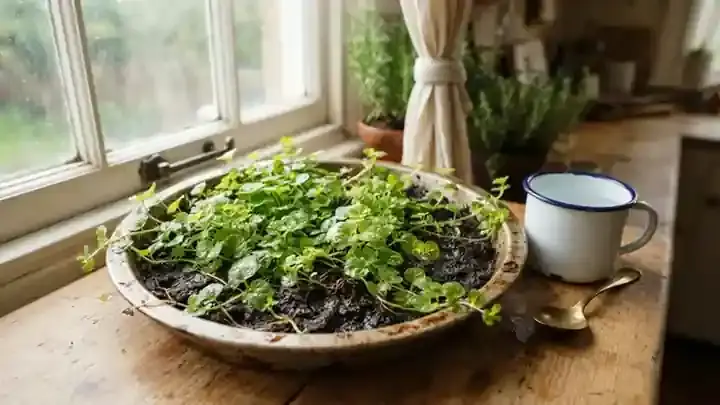
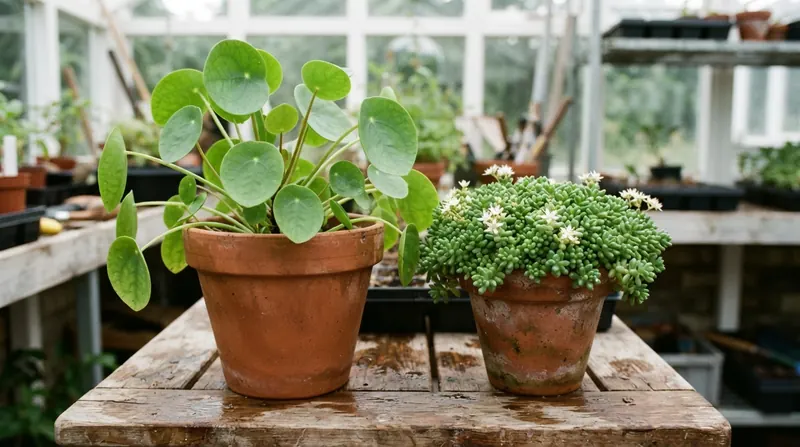
The pie tin held a plant I'd never grown.
Small round leaves on long stems, each leaf about the size of a quarter, with a scalloped edge like a child's drawing of the sun.
The stems ran along the surface of the soil and put down roots wherever they touched.
Padma had it growing in a shallow pan of black, wet earth, wetter than anything I'd ever been taught to keep a plant in.
"Vallarai," she said, which is its name in Tamil, the language of her mother's kitchen. "Your books call it *Centella asiatica.*
The shops here call it gotu kola, and some people call it brahmi."
The word *kola*, she said, has nothing to do with the kola nut in a soft drink.
I knew that, as a botanist, but I'm glad she said it, because half the people I've told this story to assumed I was drinking cola.
It's a creeping plant in the carrot and parsley family, a cousin of the things in my vegetable bed.
In much of South and Southeast Asia it grows along streams, rice paddies and ditches, anywhere the ground stays wet.
In Padma's mother's kitchen, the fresh leaves went into a green chutney, ground on a stone with coconut and a little tamarind.
"My mother made it on exam weeks," Padma said, and smiled, "because her mother made it on exam weeks."
I want to stop on that sentence, because it's the most honest description of a tradition I've ever heard. It isn't a study;
it's a grandmother's kitchen, passed down to a chemist in Ohio.
And then the confusing part, which I promised myself I'd print in large type. In India, the word "brahmi" gets used for two different plants.
One is Padma's round-leafed vallarai, the one in the pie tin.
The other is a small-leafed creeping water plant called *Bacopa monnieri*, which looks nothing like it if you put them side by side.
Depending on which part of India your grandmother came from, "brahmi" meant one or the other.
The two plants have different chemistry and very different research files, and I'll come back to that, because it matters more than anything else in this column.
Why a Chemist Trusts a Spoon and a Bag
The next morning Padma came back with the bag. It was a kraft paper pouch, dark green, from a company called Banyan Botanicals in Albuquerque, New Mexico.
"The pie tin is for the windowsill," she said. "But one pan of vallarai doesn't make enough leaves for an Ohio winter, and I don't have my mother's grinding stone."
She'd been taking the powder for about two years. A quarter teaspoon, stirred into a cup of warm water, while the kettle cooled from her morning tea.
I asked her the question I'd have asked a student who brought me a theory. "And what does it do?"
She laughed.
"I'm not telling you it does anything to your words," she said, "I'm telling you it's the green taste of my mother's kitchen, and it reminds me every morning to do the other things."
The other things, it turned out, were three.
She walks the river trail with her sister-in-law, she's learning to play the harmonium at seventy-two, and she never, ever misses the garden club potluck.
I've thought about that answer a great deal since. She didn't promise me anything, and she didn't use a single long word;
she gave me a spoon, a habit and a seat at a table.
In my experience,
people who are selling you something give you promises; people who care about you give you a spoon and a chair.
That same week, I put the bag on the top shelf in the greenhouse. Then I did the biology teacher thing:
I decided to read every line on it before it went anywhere near a cup.
The Bag, Read Like a Lab Report
So here's what I did with the bag, the way I used to grade a lab report.
I read every line, front and back, and then I went to the company's own website and read every line there too.
I'll go in order, because order matters. Whatever a company prints biggest is what it wants you to notice; whatever it prints smallest is usually what you need to know.
The name. The product is called "Gotu Kola (Brahmi) powder," which already tells you the seller means Padma's plant and not the other one.
The front of the bag says "Powder," "Gotu Kola" and, in italics, *Centella asiatica*, which is exactly the name I'd have written on the board.
The ingredient line. One ingredient: gotu kola (brahmi) aerial parts, *Centella asiatica*, certified organic.
"Aerial" means the parts above the ground: the leaves and stems, dried and ground.
There's no sweetener, no flavoring, no filler listed, and no word on the line I'd need a dictionary for.
The size. The small bag says 3.5 ounces, or 100 grams, and the label calls it an herbal supplement, with the USDA Organic seal and a B Corporation mark.
The bag itself is kraft paper with a food-grade liner inside, according to the company, to keep out moisture and air.
It zips at the top, which matters more than you'd think for a powder you'll open every morning.
The directions. "Take ¼ to ½ teaspoon with warm water, once or twice daily, or as directed by your health practitioner."
The caution line, which is the line I'd circle.
It asks anyone who is pregnant or nursing, already taking something daily from a clinician, or managing a health condition to check with a health practitioner before using it.
The statement at the bottom of every page.
The seller's site carries the standard sentence that its statements have not been evaluated by the Food and Drug Administration, and that its products aren't intended to stand in for medical care.
That sentence is the most honest line on any supplement label. It outranks every other line, including the name and including anything printed on the front.
And the front is where I'd make a note in red pen.
The bag carries a category word that I won't repeat, plus the words "Cognitive Function" with a small asterisk beside them.
That asterisk points straight down to the FDA sentence. In my classroom, a claim with an asterisk was a hypothesis, not a result, and I'll show you what the research says instead.
What the Studies Say About Gotu Kola, Including the Shrugs
I spent three afternoons at the county library, and Gene drove me twice because he wanted to see what a literature review looks like from the passenger seat.
Here's what the file says, and I'm going to print the shrugs in the same size type as everything else.
Study one is small, and I'll say so first.
In 2008, researchers in Thailand gave healthy older adults an extract of gotu kola or a placebo for two months, and measured how they did on tests of memory and attention. [1]
There were 28 people in all, about seven in each of four groups. That's fewer people than sat in my third-period class.
Only the highest dose, 750 milligrams a day of a water-based extract, was associated with better working-memory performance and higher self-rated alertness. [1]
I want to be fair to that study and fair to you.
Seven people per group is a pilot, not a verdict, and an extract in a measured dose is a long way from a quarter teaspoon of ground leaf in a cup.
Study two is the one I'd want my students to read.
In 2017, a team pooled the randomized trials of gotu kola they could find into one analysis, which is what scientists do when single studies are too small to trust. [2]
Across the pooled trials, Centella asiatica showed no significant effect on cognitive test scores compared with placebo.
The same analysis did find higher self-rated alertness.
— Puttarak P. et al., Scientific Reports, 2017, Meta-analysis of randomized trials of Centella asiatica[2]
I respect that paper enormously. A team that pools the trials and prints "no significant effect" about the plant it's studying is a team I'll believe on other things.
And the second half of the finding is worth reading carefully too. People who took gotu kola said they felt more alert, but the tests didn't measure a difference in their scores.
That's not nothing, and it's not a marvel. It's the kind of finding I'd have written in the margin of a student's lab report as "interesting; needs a bigger sample."
Now the other brahmi. If you search for brahmi, most of what you'll find is about *Bacopa monnieri*, the small-leafed water plant, and its research file is bigger.
In one 2008 trial of adults 65 and older, 300 milligrams a day of a standardized bacopa extract for twelve weeks was associated with better delayed word recall than placebo.
Other measures didn't differ, and stomach upset was the most common side effect. [3]
A 2010 trial of adults over 55 found a bacopa extract associated with better verbal learning and delayed recall, again with no difference on other measures and more stomach complaints. [4]
And a 2014 review of nine bacopa trials, 518 people in all, found faster scores on two measures of attention speed, and asked for a large well-designed trial before anyone draws a firm conclusion. [5]
Here's the whole point of the bacopa paragraphs: bacopa is not in this bag.
I mention it only so nobody reading this column credits Padma's powder with a study that belongs to a different plant.
I've seen that sleight of hand on other labels.
A company sells one brahmi and quotes the research on the other, like a student who copies the right answer from the wrong question.
So here is the whole research file, written the way I'd summarize it for a parent conference.
One small trial with an extract, one pooled analysis that found no difference on the tests but more alertness by self-report, and no study at all on this particular bag.
That's an honest leaf with a long kitchen tradition and a thin research file.
For a woman with a pencil and a clay pot label, an honest leaf was exactly what I wanted to try.
A Quarter Teaspoon, Warm Water and the Watering Can
So I took the bag down from the top shelf.
Here's the ritual, laid out the way I'd lay out a procedure for a substitute teacher, because the ritual turned out to be most of the point.
Step one: the warm water, not boiling, because the label says warm.
I run the kettle while I water the Row, and by the time I've reached the last pot it's cooled to something I can hold.
Step two: the spoon. A quarter teaspoon, level, from the measuring set I keep in a jelly jar on the bench.
I started at a quarter and stayed there.
The label allows up to half, once or twice a day, and I didn't see a reason to begin at the top of a range.
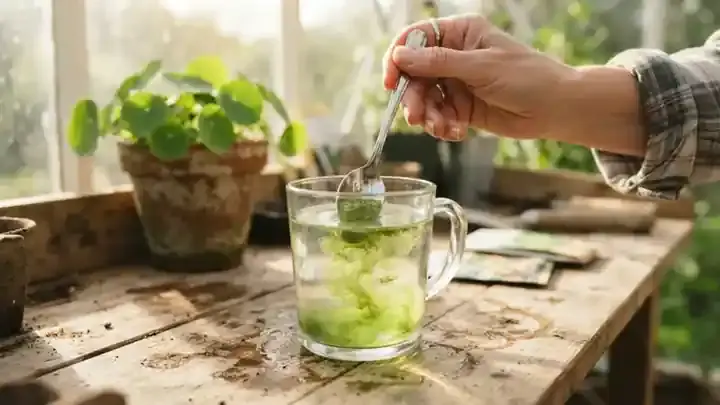
Step three: the stir. The powder doesn't dissolve the way sugar does; it's ground leaf, so it hangs in the water and settles if you let it sit.
I stir, drink about half, stir again and finish it. Padma does it the same way, and she says her mother stirred the chutney in exactly the same rhythm.
Step four: the pencil. After the cup, I take the clay pot label off the bench and make my marks from the day before, if there are any.
That's the whole procedure. No measuring cups, no blender, nothing to swallow whole with a glass of water; just a kettle, a quarter teaspoon, a stir and a pencil.
The taste, since everybody asks. It's bitter, and I'd rather you hear it from me than from your own tongue on the first morning.
The company's own description lists its tastes in the Ayurvedic way: bitter, astringent and a little sweet. That's honest, and it's in that order for a reason.
The first cup tasted like a lawn after it rains, if the lawn were also slightly disappointed in you.
Gene tried it once and said it tasted like mowing day, which he meant as a criticism and I took as a compliment.
By the second week, I'd stopped noticing.
By the fourth, I'd started adding a half teaspoon of clover honey from the farmers market, which is the only change I made to the label's directions.
The seller's own summary of its reviews says that some customers complained about the bitter taste. If you only like sweet things, you'll be one of them, and that's fair.
Six Things This Spoon Is Not, Written Before Anything Else
Before I tell you what twelve weeks of marks said, I want to list what this powder is not.
In a lab report, the limitations section comes before the conclusion, so nobody mistakes one for the other.
It is not medicine. It's a ground leaf in warm water, sold as an herbal supplement, with the standard FDA sentence printed on every page of the seller's site.
If your clinician has given you anything for anything, the spoon sits beside it, never in place of it.
That sentence is underlined on my clay pot label, and it belongs underlined on yours.
It is not something you swallow whole.
There's nothing to count out of a bottle and nothing to chase with a glass of water; it's a powder you stir and drink.
It is not the other brahmi. It's *Centella asiatica*, the round leaf in Padma's pie tin, and not *Bacopa monnieri*, which has a different research file entirely.
It is not a pick-me-up. Gotu kola isn't one of the caffeine plants, the bag lists only the leaf, and the kola in its name is not the kola nut.
It is not a shortcut.
The company's own guarantee page says herbs are often taken for four to six weeks before people decide whether they suit them, which is a long time to be patient with a bitter cup.
And it is not for everyone: the label itself says to ask first if you're pregnant, nursing, already taking something daily from a clinician or managing a health condition.
I'd add one more line: if a new herb has ever upset your stomach, start at the bottom of the range.
My pharmacist read the back of the bag for me in about a minute. She said, "One plant, organic, no amounts beyond the spoon;
tell your clinician you're taking it," and that is exactly what I did.
Morning, Adele. Gene's order is ready whenever you're by the store.
9:12Thank you. Could I bring that green bag by for you to read the back?
9:20Of course. Bring the list of everything you both take, too.
9:21I'll write it on a recipe card. After my walk, around ten.
9:23
What Customers Wrote, and What They Didn't
I'm one woman with one clay pot label.
So I went looking for what other people had said about the same bag, and I'm going to show you what the seller's review page actually displays.
When I read it in October, the page showed 38 reviews with an average of 4.71 stars. The spread: 34 five-star reviews, no four-star, 2 three-star, 1 two-star and 1 one-star.
One honest note before the reviews. Those 38 reviews aren't all about this exact powder;
at least one reviewer was clearly writing about a tablet form of the herb, so I won't pretend the average belongs to the bag alone.
The photos next to each review below are illustrative portraits, not the reviewers themselves; the seller's page publishes names, not faces. The words are theirs, copied exactly.

Great! Thank you

Good, high quality product.

Fast delivery and really good quality.
Notice what those three reviews talk about. Quality, delivery, a thank-you; not one of them claims anything about anybody's words or names.
I like that, and I'll tell you why. Those are the reviews of people describing the thing they could actually check: the bag arrived, it was what it said, it was good.
Other reviewers on the same page describe effects they felt, in their own words, and I'm not printing those here.
They describe their own experiences, they aren't a study, and some of them aren't about this form of the herb.
The negative reviews are worth knowing about too.
One customer wrote that a recent batch felt sandy and looked browner than the bright green she was used to, and another complained that a large bag lost its freshness before he could finish it.
The company replied to both. To the second, it said its bulk powders don't carry an expiration date and that it recommends using them within three years of purchase.
That's my reason for buying the small bag.
A 3.5-ounce bag of a single leaf, opened every morning and zipped shut, gets used up long before anybody has to wonder whether it's still fresh.
And one more reviewer wrote a long, funny complaint about the taste that I won't quote, but I'll summarize.
He compared it to a barnyard, and then admitted he kept drinking it anyway.
Here's how I read all of it together. The bag is a single organic leaf that customers say arrives quickly and looks like what it claims; the taste divides people;
and what anyone felt is their own experience, not a finding.
Twelve Weeks of Marks, Good Weeks and Bad Ones
I started on Monday, August 4, the week after Padma brought the bag.
I'd like to say I started out of hope, but I started out of stubbornness, because Padma was going to ask at the potluck.
I moved my marks from the clay pot label to the seed calendar that hangs by the greenhouse door. One square per day, pencil, and I added a second column:
where I was standing when the word came back.
Adele's seed calendar, August to October
- Week 1A quarter teaspoon in warm water every morning after watering. Bitter. Five marks that week, the usual. Gene called the greenhouse "the hay barn."
- Week 2Nothing. Same marks, same pauses. Wrote "nothing" four days running and nearly gave the bag back to Padma over the fence.
- Week 3Started naming every plant on the Row out loud while I water, Latin first. Back to the garden club potluck with deviled eggs. Sat by Padma.
- Week 5Said "Loretta" at the mailbox before I'd even crossed the street. Wrote it in the margin and drew a box around it.
- Week 6Walked the river trail with Padma and her sister-in-law three mornings. Four marks that week, three of them on the same tired Sunday.
- Week 8A summer cold and two poor nights. Nine marks in one week, the worst since June, and I wrote them all down in the same size pencil.
- Week 12Back to the clinic with the seed calendar rolled up in my tote bag.
I want to slow down on week two, because it's the week most people quit.
Four lines in a row that say "nothing," in the handwriting of a woman who already suspected she'd been talked into a bitter cup.
What kept me going was the sentence I'd said to thirty-one years of sophomores. You don't judge a plant by one Tuesday.
Week three is where things change, and I want to be honest about why.
That's the week I started saying the Latin names out loud while I watered, and the week I went back to the potluck.
Three things changed in week three, not one. A careful scientist doesn't credit the fertilizer when she also moved the pot into the sun.
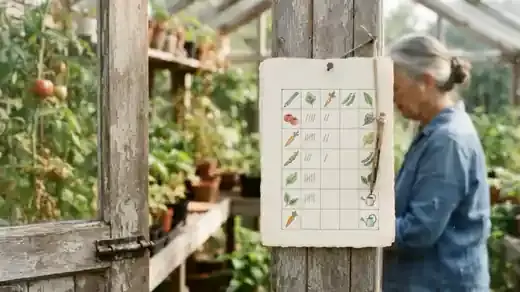
Week five was Loretta. I came out for the mail, she was getting hers, and her name was simply there, in my mouth, before I'd decided to reach for it.
It's a small thing to write in the margin of a seed calendar.
I drew a box around it anyway, the way I used to box the final answer at the bottom of a lab report.
Week eight was the cold, and I'm printing it because a lab notebook that skips the bad week isn't a lab notebook.
Two poor nights, a box of tissues and nine marks in seven days.
I didn't throw the calendar out.
I wrote every mark down, kept my quarter teaspoon in the morning, and let Gene do the watering while I sat on the step stool and supervised.
By week ten the marks had gone back to the shape of week six. Most days none, some days one, the odd tired Sunday two or three.
That's not a scientific measurement, and I'd fail any student who called it one.
It's a pencil record kept by a woman who was looking for a reason to quit and kept not finding one.

Week ten was Owen again. He came for the weekend and asked about the spider plant, the same way he had in June, finger on the leaf.
"*Chlorophytum comosum,*" I said, and he made me spell it, and then he made me do every plant on the Row. We played it for an hour, and I lost three;
he kept score on a clay pot label.
I'd like to tell you the powder did that. The honest sentence is that I can't tell you which of the things I changed did what, and neither could anyone else.
Owen told me you know the Latin for every plant on the Row. He's very impressed.
6:48I missed three. He kept score on a pot label and he was not merciful.
6:52He's your grandson. Are you still doing Padma's green cup?
6:53Every morning after the watering, still bitter, still counting. Potluck Thursday.
6:55What the Clinician Said About a Rolled-Up Seed Calendar
In late October, I went back to the clinic with the seed calendar rolled up in my tote bag and a sharpened pencil in case anybody needed one.
My clinician unrolled it on the exam table and read it the way I used to read a good lab notebook: slowly, from the beginning, without skipping the bad week.
"You walked the river trail twenty-six times," she said. "You went back to your club.
You started saying the plant names out loud. You know those are the columns I care about, don't you?"
I did know that. And here's the most honest sentence I can write about the powder: I cannot tell you which square did what.
In twelve weeks I walked more, went back to the people, said the Latin names out loud every morning, and drank a bitter quarter teaspoon of a leaf.
Any one of those could be the reason for fewer marks, or all of them together, or the season simply changed.
What I can tell you is the order of things. The powder didn't walk the river trail; Padma and I did that.
But the cup sat at the start of every morning, and every morning it reminded me to do the other things.
That's exactly what Padma told me it would do, back in August, and it's the only thing she ever promised.
Padma wrote that after she counted. I hadn't counted; Padma counts everything, including the number of times I said "it's nothing" in August, which was eleven.
And notice the order she wrote it in: the spoon, the trail, the table. The spoon rides along; it never drives.
Where the Spoon Actually Fits in a Day
People ask what a day looks like now, as if there were some grand new regimen. There isn't, and that's the point.
6:30 a.m. Coffee with Gene on the back step, which is not negotiable and never will be.
7:00 a.m. The watering: twelve pots on the Row, Latin names out loud, the kettle running in the kitchen.
7:20 a.m. The quarter teaspoon, warm water, the stir, half the cup, the second stir; then the pencil and the seed calendar, if there's anything to mark.

8:30 a.m., three days a week. The river trail with Padma and her sister-in-law, Kavitha, who walks faster than both of us and never lets us forget it.
Afternoon. Whatever's hard: the garden club minutes, the newspaper crossword with the cover folded back, a chapter of a book about ferns I've been meaning to read since 1997.
Thursday evening. The potluck, deviled eggs, a chair next to Padma.
That's why I trust it, honestly. A habit that asks a quarter teaspoon and two stirs of your morning is a habit you'll still be keeping in October.
The word-game app asked for my attention every hour and lasted two months. The fourteen-ingredient canister asked for $44.95 and my whole vocabulary;
the spoon asks for a kettle I already owned, and it's still on the bench.
How to Keep a Seed Calendar for the Words
More readers have asked me about the marks than about the powder. So here's the method, exactly as I keep it, and it works for anything you're trying, including nothing at all.
Buy the cheapest paper calendar in the store. A garden-center giveaway is perfect; a fancy journal makes you write fancy sentences, and fancy sentences fib.
Hang it where the watering can is. Mine is on a nail by the greenhouse door, so I can't start the day without walking past it.
One mark per word that slipped away, and nothing else. No essay, no grade, no "I'm terrible today"; a mark is an observation, and a confession is not.
Write down where you were when the word came back. You'll learn things: mine come back while I'm watering, walking or washing dishes, almost never while I'm straining for them.
Write the bad weeks in the same size pencil as the good ones.
That's the rule most people break, and it's the rule that makes the calendar worth anything.
Read it once a week, not once a day. Daily reading makes you jumpy about Tuesday; weekly reading shows you the shape of the month.
Take it to your appointment. My clinician unrolled mine on the exam table, and she said it was more useful than anything I could have told her from memory.
That last rule is why I'd keep a calendar even if Padma had never crossed the alley.
A twelve-minute appointment goes a lot further when you walk in with twelve weeks of pencil.

What Readers Wrote When This Ran as a Short Column
A shorter version of this column ran in the garden club newsletter in September. The comments were better than the column, which is usually how it goes.
The comments below are illustrative, retold from reader notes with names shortened. Replies sit indented under the comment they answer, because they ask what you're probably asking.
Ernest's comment is the one I've thought about most. "Told everybody it was my hip."
I did the same thing with the potluck. We invent a respectable reason, because the real one feels like a confession, and a confession at our age feels like a verdict.
And Ruthann's comment is the reason I'd print the research file again tomorrow. Whatever you try, read the Latin on the back, then check the study against it;
the plant in the study ought to be the plant in the bag.
Ten Questions That Came Over the Back Fence
After the short column ran in the newsletter, I got more letters than I've had since my retirement party. I've answered the ones that asked what most of the others asked.
The letters behind these questions are illustrative composites, retold from reader notes. The answers are mine, the same ones I'd give over the back fence.
Short answers to the questions Padma and I get at the potluck
How do you take it?
A quarter teaspoon of the powder in a cup of warm water, stirred twice, after the morning watering. The label says ¼ to ½ teaspoon with warm water, once or twice a day.
What does it taste like?
Bitter first, then a little astringent, like strong green tea left too long, with a faint sweetness at the end. The seller lists its tastes as bitter, astringent and sweet, and its own review summary says some customers complained about the bitterness.
Is gotu kola the same as bacopa?
No. Both are called brahmi in parts of India, but gotu kola is *Centella asiatica*, the round-leafed plant in this bag, and bacopa is *Bacopa monnieri*, a different plant with a different research file.
Does it have caffeine?
The bag lists one ingredient, the gotu kola leaf, and gotu kola isn't a caffeine plant. The "kola" in its name has nothing to do with the kola nut.
Will it bring my words back?
Nobody honest can promise that, and the seller's FDA statement says its claims haven't been evaluated. The best pooled study found no difference on test scores, with more alertness by self-report, and my own calendar can't say which of the things I changed did what.
Can I take it with my other things?
The label asks you to check with your health practitioner first if you already take something daily from a clinician, if you are pregnant or nursing, or if you manage a health condition. Show the bag and your list to your pharmacist.
Which size should I buy?
I'd start with the 3.5-ounce bag at $11.99. The larger bags cost less per ounce, but the small one gets used up while it's fresh, and you'll know by then whether you can live with the taste.
How should I store it?
Zipped shut, air squeezed out, somewhere cool and dark. The company says its bulk powders don't carry an expiration date and recommends using them within three years of purchase.
Who makes it, and how do I reach them?
Banyan Botanicals, 6705 Eagle Rock Avenue NE, Albuquerque, New Mexico 87113. Phone or text 800-953-6424, weekdays 7 to 5 Pacific; email info@banyanbotanicals.com.
What if I don't like it?
The Banyan Guarantee accepts returns within 90 days of purchase for a refund of the price paid for the products. It doesn't mention shipping, so ask by phone if that matters to you.
Padma and I, Recorded for the Garden Club Newsletter
In October, the newsletter asked whether Padma and I would let them record one of our greenhouse conversations for the "Members" page. Padma said yes before I could say no.
Here's the transcript, trimmed only for the parts where Gene came in to ask where the good pruners were.

Members · The Potting Bench Tapes, Episode 3
Two Neighbors, One Pie Tin and a Seed Calendar
Adele
host
Padma, the newsletter wants to know why a retired chemist carried a pie tin of wet soil across the alley in August.
 Padma
guest
Because your chair at the potluck was empty, and you're the only one who brings deviled eggs without paprika. I needed you back for purely selfish reasons.
Adele
host
And the bag? You could have brought a casserole.
Padma
guest
A casserole is for after something sad happens; a spoon is for every morning. My mother put vallarai on the table every exam week, and I thought you were having an exam week.
Adele
host
I went to the library, you know: one small trial with an extract, one big review that found no difference on the tests, and half the internet confusing your plant with bacopa.
Padma
guest
I never told you it was in a study; I told you it was my mother's kitchen and that it would remind you to do the other things. You're the one who went looking for footnotes.
Adele
host
Fair enough, so tell the newsletter the honest version. What does it do?
Padma
guest
It tastes like a wet field, and a small bag costs about twelve dollars; for twelve weeks it sat at the start of your morning while you watered, walked with Kavitha and me, and came back to the table. Whatever your calendar shows, you earned it with your feet and your mouth.
Adele
host
And what would you tell somebody standing in a grocery aisle right now, waiting for a name to come home?
Padma
guest
Say hello anyway; the name comes back faster when you're not hiding. Then go home, hang a calendar by the door, and if you want a spoon in the morning, read the Latin on the back first.
Padma listened to the recording afterward and asked for one correction. She wanted it on the record that her mother's chutney had more tamarind than she let on, which her sister-in-law disputes.
I've gone back to that last line of hers more than any other. "Say hello anyway; the name comes back faster when you're not hiding."
3.5 oz bag of organic gotu kola powder · read the guarantee below before ordering
The Guarantee, Read Like a Syllabus
Now the part most columns skip, and the part I'd have read first: what happens if it isn't for you.
I read the seller's guarantee page twice, the way I used to read a new district policy before I signed anything.
Here it is in my own words, with the important sentence quoted exactly.
The Banyan Guarantee, in plain words
"If for any reason you are not satisfied with one of our products or if one of our products does not support your health in a way that meets your expectations, we will gladly accept returns within 90 days of purchase for a refund of the price paid for the products."
That is the seller's own sentence, read on its help pages in October 2026. Banyan Botanicals · 6705 Eagle Rock Ave. NE, Albuquerque, NM 87113 · 800-953-6424 · info@banyanbotanicals.com
Ninety days is a long window.
It's longer than the twelve weeks I kept my calendar, which means a person could keep her marks for the whole season and still decide the bitter cup wasn't for her.
The words "the price paid for the products" matter.
The page doesn't say shipping is refunded, so I'd assume the $5.95 you paid to get it to your door stays spent, and I'd call to ask if that matters to you.
The same page makes a suggestion I respect. It says Ayurveda "often requires a bit of exploration," and that people often take herbs for four to six weeks before deciding.
That's the seller telling you, in its own guarantee, not to expect anything on the first Tuesday. I'd have put that sentence on a poster in Room 114.
Shipping, for the record. Within the contiguous United States, it's $5.95 on orders up to $29.99, $6.95 from $30 to $59.99, and there's no shipping charge on orders of $60 or more;
Alaska, Hawaii and Puerto Rico are asked to inquire.
So a single 3.5-ounce bag comes to $17.94 before tax, and I'd rather you see that number here than at the checkout.
The company also takes HSA and FSA cards, according to its site, if you have one of those.
The company is Banyan Botanicals, and it prints a street address in Albuquerque on every page of its site.
It publishes a phone number you can call or text, 800-953-6424, Monday through Friday from seven to five Pacific, plus a live chat and an email address.
A street address, a phone that answers and a guarantee with a number of days in it.
My checklist for any field-trip vendor was three lines long, and this bag ticked all three before I got to the taste.
Who This Bag Is For, and Who Should Skip It
I wouldn't end a unit without a review sheet, so here's mine. Fair notice: half of it tells some of you not to buy.
It probably makes sense to look at it if:
- You want a small morning habit with your hands busy, not something to swallow whole
- You don't mind a bitter, grassy cup, or you're willing to add a little honey
- You'd rather read one plant name you can look up than fourteen you can't pronounce
- You like a tradition you can trace to somebody's grandmother's kitchen
- You'll actually keep a calendar and take it to your next appointment
It probably isn't for you if:
- You want a promise about your words or names; nobody honest can give one, and the seller's FDA line says so
- You only like sweet drinks; the bitterness is real
- You were hoping for bacopa; this is a different plant
- You're pregnant, nursing, already taking something daily from a clinician or managing a health condition, and haven't asked your health practitioner yet
- You'll buy the one-pound bag on the first try; start small
That first line on the second list matters most.
This is a spoonful of a leaf, not a plan; the plan is whatever you and your clinician write down together.
What a Bag Costs Against What I Already Spent
Now the money, because Padma made me promise I'd put it in black and white. The small bag is $11.99 for 3.5 ounces, or 100 grams, of a single ground leaf.
The bag doesn't print how many quarter teaspoons it holds, and I'm not going to guess on paper.
What I can tell you is what an ounce costs at each size the seller lists.
I'm not saying the $100 was wasted because the bag is cheaper.
I'm saying the $100 was spent on things I couldn't evaluate, and the $11.99 is one plant I can look up, in a bag I can read.
If the taste suits you, the larger bags bring the ounce down by about a dollar.
If it doesn't, the small one is the cheapest way to find out, and the guarantee covers the price paid for ninety days.
Where the Bag Stands, Line by Line
Here's the summary I'd staple to the front of the report. If you only remember one part of this column, make it this one.
✓ One organic ingredient, printed plainly: gotu kola aerial parts, *Centella asiatica*, with no sweetener, flavoring or filler listed.
✓ A 90-day guarantee with a refund of the price paid, a street address in Albuquerque, and a phone line you can call or text on weekdays.
✓ A small morning habit: a quarter teaspoon, warm water, two stirs, nothing to swallow whole.
✓ A long kitchen tradition in South Asia, told honestly as a tradition and not dressed up as a finding.
✗ A thin research file. One small trial used an extract, and the pooled analysis found no difference on test scores, with more alertness by self-report only. [1] [2]
✗ The bigger brahmi file belongs to another plant. The bacopa trials are not about this bag. [3] [4] [5]
✗ It's bitter. The seller says so in its own taste notes and its own review summary.
✗ The front of the bag says more than the research does. Read the asterisk, and then read the FDA sentence it points to.
If You're Standing in Your Own Grocery Aisle
I can't tell you what to do.
I can tell you what I'd do if I were reading this column instead of writing it, back in June, with a spider plant whose name wouldn't come.
First, before you buy anything at all: hang a cheap calendar by the door you use most, and make one mark for each word that hides.
Second: tell your clinician at your next visit, and bring the marks.
A word that comes back late is a different thing from a word that never comes back, and only somebody who can examine you can tell the two apart.
Third: go back to whatever you've been avoiding. The potluck, the breakfast, the bridge table, the choir; the people are most of what makes a good week, and nobody sells them.
And fourth, if you'd like a small morning habit and your clinician is behind you: read the label I've been describing for this whole column.
One organic leaf, a quarter teaspoon, warm water, $11.99 for the small bag.
I won't pretend a link at the bottom of a greenhouse column is anything but a door to the seller's shop. The Brahmi Row doesn't keep inventory; we keep pots.
But if you walk through that door, you'll know exactly what's on the other side: one plant, a bitter cup, a ninety-day guarantee and a phone line in New Mexico.
Ground gotu kola leaf · ¼ teaspoon in warm water · start with the small bag
One more thing, and then I'll let you get to your own morning.
The seed calendar still hangs by the greenhouse door, between the watering can and the jelly jar of measuring spoons.
Yesterday's square reads: "Oct 25. Watered the Row.
Zero marks. Said *Tradescantia* to Owen on the phone without stopping.
Potluck Thursday, my turn for eggs."

Zero marks. Two words, in pencil, written by a woman who once skipped two potlucks to avoid a pause.
P.S. The first clay pot label, the one with nineteen marks, is tucked inside the seed packet tin now, and if you have a Padma in your life, thank her; if you are the Padma, carry the pie tin across the alley anyway.
P.P.S. Remember the order Padma wrote on her note, the spoon, the trail, the table: the spoon is the smallest of the three, and it's the only one that comes in a bag.
The full ingredient guide, with a note on the leaf, the two brahmis and the advertising around this bag, is linked at the foot of this page.
First, the people: Adele Whitcombe is a pen name. Padma, Gene, Loretta and the garden club are composites, the way gardening columns have always been written.
Everything about the green powder itself, its label, its price, its directions, its reviews and its guarantee, comes from the seller's own pages, read in October 2026.